Saturday, 27 November 2010

Multilingual woes and joys

Opinions have divided rather neatly about what being multilingual does to you, ever since multilingualism became worthy of attention in Western(-like) parts of the world.

Early views about multilingualism took it as only marginally less noxious than the plague. Today’s views market it as wholesale cure for all human woes, from dissolving cognitive rust to ensuring world peace. Few of us seem willing to agree that multilingualism is about as exciting as monolingualism: you go about your daily business using whatever linguistic resources happen to be relevant for going about your daily business.

Multilingualism is currently good for you: we should pop a couple of tablets of it every day, to keep us healthy. It triggers assorted enhancements, which leads to the interesting conclusion that most of the world’s population must be enhanced. But – there’s always a but – we should also beware of side effects.

Trendy headlines first extol unqualified “benefits” of multilingualism. Then the small print reveals that the research which is invoked to support trendy claims uses very, very careful language: possible correlations are suggested in specific areas, according to experimental investigation of a restricted number of informants of a particular age in particular settings, depending on how the data are analysed. The small print also reveals that there are “costs”.

Benefits and costs are, as usual, calculated against monolingual benchmarks. We are told, for example, that multilinguals are more gifted socially than monolinguals, but take a few milliseconds longer to retrieve names of objects from memory. The reason is attributed to the milli-time that a multilingual brain takes to decide which language is the relevant one to provide the required answer in. Although I am not aware of research showing the impact of millisecond lags on everyday communication, the message is that we trade off instant brain responses for more elaborate social skills, or vice versa. Milliseconds, incidentally, were also found of relevance when comparing the achievements of “late” multilinguals and “native speakers”, an issue to which I will come back in due time.

We are also told that multilingualism vitalises the mind, but results in poorer vocabulary in each language. I confess that I’m not entirely clear about what reports like these are meant to mean. Is it that monolinguals have astonishing vocabularies and dull minds? By the same reasoning, that would be the benefit and the cost of being monolingual, respectively. I also have some difficulty with the labels that are used to announce these reports. Speaking of multilingual response delays and poor vocabulary is, to me, a little too close for comfort to the terminology of suspected language disorder.

The decisive argument pro-multilingualism is usually said to be that, despite any costs, it rewires the brain. But so does motherhood, as reported in studies that, to the best of my knowledge, investigated monolingual pregnancies, and so does driving taxis, including monolingually, in London.

In short, the arguments about multilingual “benefits”, today, strangely remind of those about monolingual “benefits”, almost one century ago. Small print and costs included. We don’t seem to have learned our lesson, because our current beliefs and our current drive are the same as one century ago, only the other way around: everyone should become multilingual. I’ll have more to say about this next time.

© MCF 2010

Next post: “We shall overcome monolingualism.” Wednesday 1st December 2010.

Wednesday, 24 November 2010

There are multilinguals and multilinguals

If you are a linguist, you’ve probably been asked the same old question over and over again: “So how many languages do you speak?” True, the word linguist can mean ‘polyglot’, a user of several languages, in some varieties of English. But in other varieties and in other languages it doesn’t, and the question never fails. If you are a multilingual, on the other hand, the questions are different: “But which one is your first language?”

Now I happen to be both, and I’m usually at a loss about how to deal with these questions. The linguist-questions appear to want to elicit a quantity. Numbers are usually seen as factual, aseptic, although I have yet to test this assumption if I answer something like “73, and counting”. Whatever the answer, the next question never fails either: “But (these questions usually start with “but”) can you understand and speak and read and write all of them?”, followed by: “But in exactly the same way?”, followed by frowns of disbelief or smug grins depending on what you say. So both the linguist-questions and the multilingual-questions in fact attempt to elicit qualitative judgements about your languages from you. A multilingual is therefore not someone who uses several languages, but one who does so properly, fluently and in other adverbially commendable ways. Some of us are more multilingual than others, it appears. George Orwell’s pigs would be pleased.

There seems to be no way out of this multilingual trap. You may be fluent in all your languages, but there is some vocabulary missing from each one. You may write in all your languages like a goddess, but your accent in one of them is not up to (someone’s) par. You may be multilingual from birth, but you may become more, or less, or more or less multilingual by retirement age. You may speak Portuguese and Spanish and Italian and Rumanian, but that’s not being as multilingual as speaking Arabic and Icelandic, or Arabic and Icelandic and Hungarian. Or conversely. Whatever you say, you lose. You are not worthy of the label “multilingual”, but you may well be worthy of labels like “unbalanced” or “semilingual”. Not conversely.

I wonder what makes a monolingual worthy of the label “monolingual”, and I also wonder whether the virtual absence of this label from language discussions reflects similar difficulties in defining monolinguals, or has some other profound significance that thoroughly escapes me. The fundamental insecurity about what multilingualism is comes from multilinguals too. “Are we OK?”, we question ourselves. “Are we entitled to say that we are what we are?”, “Hadn’t we better agree that we have one “good” language, just to save face?” Unless the querier is, say, a head-hunter, I never understood the probing purpose of questions about language quality which, if you are head-hunting, you also ask of monolinguals. But for employment purposes, qualitative competence in your language(s) is as much an asset as qualitative competence in the job you’re seeking. You won’t get employed without either of them.

Questions like these assume that damage is being done to languages: bits and pieces are missing from them, or being pasted onto them, or both, unlawfully. And we cannot assume injury to languages if we don’t also assume that languages are the idealised, confined, boxed-up objects that have shaped thinking about them for (too) many years. Languages have been confused with what some people take to be their building blocks, words and sounds and phrases, that reside in stable edifices somewhere within us. Refreshing our thought pathways along the languaging lines that I suggested earlier might help: languages are ongoing human interaction. Roy Harris makes this clear, with his insight that linguistic practices are necessarily integrated with other human practices. As he puts it, all communication demands “continuously monitored creative activity”.

We can choose to use language, or a language, to communicate; we create tools and words to serve our needs; we turn nouns into verbs and verbs into adjectives, just like we can use a stone as a hammer and toothpicks as cocktail decorations, as and when we see it fit, which means fit for our purposes. Languages are what we all do with them, whether we’re monolingual or multilingual: we shape them to our needs because we need them in order to make them work for us.

Assuming that languages have definable contents, and therefore definable boundaries, and that they therefore exist in definable numbers, is what baffles us about the “many languages” of multilinguals. No wonder, then, that we find mind-boggling fluctuations in the appraisal of the “effects of multilingualism”, to use a popular expression. I’ll talk about this in my next post.

© MCF 2010

Next post: Multilingual woes and joys. Saturday 27th November 2010.


Saturday, 20 November 2010

Brains and fears

Brain matters tend to become profoundly distorted in popular convictions, and sometimes in less popular ones too. This could well be because we haven’t yet found a way of dealing with brains without using our brains. Here, for example, is a common representation of the human brain:

The human encephalon, according to some human encephalons.
Photo: Sheila Thomson (Wikimedia Commons)

In what concerns languages, this view matches the misconception that languages are boxed up into brain compartments, that I mentioned before. The same view has led to the belief that each language takes up (precious) brain space from other languages (read: from your single “main” language), or even from other intellectual abilities.

It is true that specific regions of the brain are in charge of certain functions, as we’re learning from research using functional neuroimaging and/or research on brain damage: certain areas of the cortex, and lesions in those areas, correlate with certain effects. But the same research also shows two other findings that somehow have failed to meet (or please) the popular imagination: that brain power also means recovery power, in that healthy cortex can take over functions of damaged cortex, and that the brain monitors itself in order to keep itself usable.

Speaking of misrepresentations, I must take this chance to set the record straight on my fellow countryman, neurologist and Nobel laureate Egas Moniz. He became less known for his own work than for the misuse that others made of his leucotomy procedure (*not* lobotomy). In addition, he is seldom credited with his other major discovery, angiography, a clinical imaging technique which has been in widespread use ever since he first introduced it in the 1920’s. Perhaps another example of how fact-starved discussions tend to mangle brain reputations?

Keeping themselves usable appears indeed to be the core job of brains. They are there to evolve, because they adapt to whatever uses they are called on to serve, throughout life. They die when we die, not before. One example has been reported for London cab drivers in 2000, and updated in 2009. The view that brains develop up to certain stages in the life of their users, to then inexorably decay, characterises last century’s thought, and cannot hold against the inherent plasticity of the human brain that current research keeps unveiling. As far as I understand, London cabbies do not exercise their functions during early childhood.

Multilinguals may be unaware that they are living proof of lively brain social networking, as it were. I have one example, about an email exchange I once had with a colleague. We are both multilingual with Swedish, and we met in Sweden, so it was only natural to continue our business, and start our correspondence, in this language. Later on, I had to look for a message, where I knew a crucial matter had been discussed. So I scanned my inbox using Swedish search words. Nothing. The message was gone. After two days of despair, my colleague wrote back to me asking why I was taking so long to fix the crucial matter. She wrote in English. She had switched language during a trip to the UK a few weeks before, and so had I, in natural response to her first message in that language. You don’t need to ask: the message had been there all the time, safely in my inbox, and in English.

To me, this is further proof that our brain doesn’t work like an inbox. When we search for things in it, we don’t need to search in languages, because the brain doesn’t seem to pay special attention to languages: it gathers knowledge and, in doing so, discards the tools that we happened to use to encode it.

Moral of the story: if you think you’re losing your usual neat control over where and how you’ve stored things around your brain, you’re not. You’re just being multilingual. Which is an interesting thing to be, in light of another quite popular issue: the lack of agreement about what a multilingual actually might be. I’ll leave it for next time.

© MCF 2010

Next post: There are multilinguals and multilinguals. Wednesday 24th November 2010.


Wednesday, 17 November 2010

Age, decay, and missed opportunities

Let’s talk about real-life tales, for a change. If the title of this post sounds gloomy, please note that it is no gloomier than popular views about language learning. The early bird gets the languages, it appears. If you’re late, you won’t just learn languages in a defective way: the full message is that you won’t be able to learn them at all. “I’m too old to learn languages” is probably second only to “Multilinguals are special people”, on the scale of linguistic urban myths. The myth of the early bird has spawned the unsettling twin beliefs that you need to gorge small children with languages before it’s too late, and that doing so provides them with an unquestionable head start in life. I will come back to both in future.

The facts are that we simply don’t know whether age is a factor in language learning at all. The reason for our ignorance is that we have no hard evidence to either prove or disprove this claim. In fair investigations, if you suspect that some X may be correlating with some Y, you do all you can to isolate X in interaction with Y. That is, you remove anything else that may also interact with Y. If you don’t do this, you’ll have no way of telling whether it was X or something else that affected Y. This is step number one. If a correlation is indeed found, step number two involves proving that X causes an effect on Y. A correlation is different from a cause: in the monsoon season, in Singapore, torrential rains are regularly preceded by wind squalls. So wind correlates with rain, but this doesn’t mean that wind causes rain.

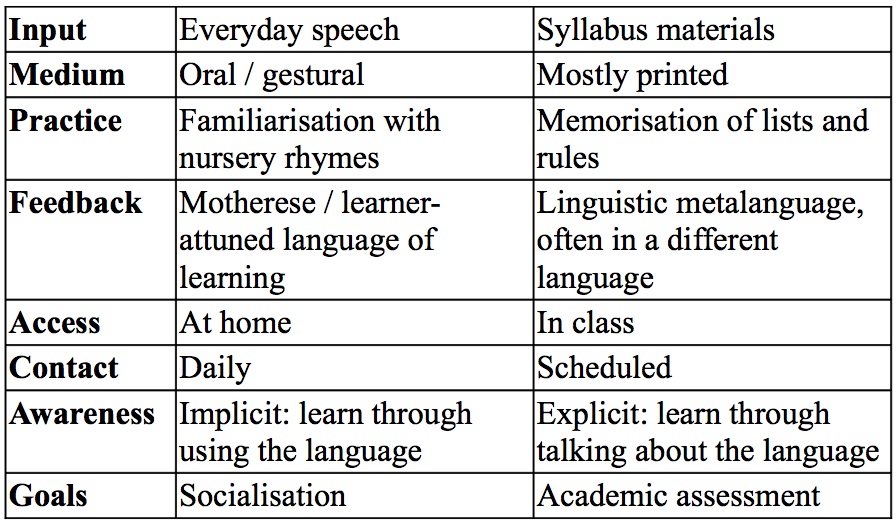
If you claim that (advanced) age is a factor, or perhaps even the factor, affecting language learning, age is your X and Y is language learning. Everything else that might have some effect on language learning, and that you are fairly aware of, should be controlled. Below is a summary of what I think is a fair sample of everyday observations about language learning. I leave it to you to supply the header row in the table, with appropriate “early language learning” and “later language learning” labels.


Saying that ageing stymies language learning is saying that you lose an ability that you once had. Some conditions are certainly degenerative: you are more likely to suffer from gout and hair loss later than earlier in life. But saying that the human brain refuses entry to languages (and why languages, of all things??) after a certain unspecified age, because it shuts down for languages at an unspecified age, is like saying that when we die, which we all will at an unspecified age, we will all be dead after an unspecified age. Nobody knows either, by the way, at what age the brain is supposed to lock its doors – or was it windows? –, including those of us who claim that there are doors and that they close.

I hope I’m making myself clear. I’m not saying that age is, or is not, the cause of differences in language learning. I’m saying that we don’t know. I am also saying that I find brain-shutdown theories of language learning quite disturbing: what they tell us is that whatever you do as a learner, you won’t succeed in learning, because your brain can’t cope with it. It certainly makes me wonder why this message doesn’t seem to have got across to the zillion-dollar language teaching and language learning corporations which, from their side, show no signs of imminent shutdown.

I’ll have more to say about brains in my next post, but let me leave you on a cheerful note. Two, actually. First, I know a few reasonably-brained individuals who, after three years of “later” Spanish-learning, were only able to say El perro está bajo la mesa, which I always thought was quite funny. But I didn’t know that there is a wonderful parody, in song format, of the same kind of communicative competence that you find yourself acquiring as a late learner. I came across it at Multilingual Mania (thank you, Melanie!). The only problem I have with this song is that it is so catchy it will stick to your mind instantly, and stay there – if your decaying musical brain is wired like mine, that is. You have been warned: it’s the One Semester of Spanish - Love Song.

The second good news is that even the brain of the dog who got sentenced to life under a table doesn’t shut down. Have a look here, in Spanish, for the sake of the dog, or here, in English, for the sake of my Spanish-learning friends.

Disclaimer: Any similarities with characters and/or goings-on in the fairy tale of my previous post are purely coincidental. This is, as said, a real-life tale.


ResearchBlogging.org
Roberts, T., McGreevy, P., & Valenzuela, M. (2010). Human Induced Rotation and Reorganization of the Brain of Domestic Dogs. PLoS ONE, 5 (7). DOI: 10.1371/journal.pone.0011946


© MCF 2010

Next post: Brains and fears. Saturday 20th November 2010.


Saturday, 13 November 2010

Little Perfect-lingual and the Big Bad Funny-lingual

I thought of treating you to a fairy tale today. This is a fitting post for the day: I’ll be talking about children and about growing up, and I’m celebrating an anniversary – or rather a mensiversary. It is exactly one month today since this blog came to be.

My tale is a cautionary one. It is about what happens to language skills when disobedient little children insist on turning into adults, and so get punished by having language gifts turned into language handicaps. Here it is.


Little Perfect-lingual and the Big Bad Funny-lingual
Once upon a time, we were all children. Our minds were like wide-open windows, the windows of opportunity, through which languages flew in and about in droves, unfettered, unencumbered, free to imprint our avid synapses with perfect grammar, vocabulary and, not least, accent. Pragmatic, discoursal, social and other generally functional uses of language, which have no business in traditional assumptions about what languages are all about, have no business in this traditional tale either.
The windows fluttered ever so gently at the gentle touch of ever more languages, whose gentle glide itself kept them opening wider and wider. Languages were growing within us. We could make ourselves understood to anyone around us, about anything that mattered to us. We were praised on our linguistic accomplishments. Life was good.
But we were not content, little rascals that we were. We had to go and grow up. For sure, we couldn’t have known, because nobody told us, that the windows had sneaky inbuilt switches that would seal them shut forever as soon as we gave signs of wanting to get rid of childhood. Even if someone had tried to tell us, how could we seriously believe that human brains suffer from scheduled power outages? We didn’t know either when the short circuit would strike. Then again, neither did those who subscribe to brain shutdown. But that didn’t matter. What mattered was that the windows would be gone and, alas!, the opportunity with them. We had missed the boat. We would never again be able to learn languages.
To prove that we were indeed past the best-before date, and that the people who say so always know best, jealous adults then stuffed us in square rooms with square furniture, crammed us in square rows of other hapless waifs, facing a square whiteboard. To add to our torment, they forced pens and paper and books into our small hands, that had hardly outgrown nursery toys. And then they told us: “You are going to learn a new language!” Or: “Open your book and read!” Or: “Now look at what I’ll write on the board and copy it onto your exercise books!” Or: “Now memorise this list of words and this list of grammar rules for next time!” Or: “Now translate these words into your old languages, so you learn what they mean in your new language!” Or: “You are going to be tested in your new language!”, over and over again.
We did try, meek and vanquished that we now were. We wanted to be grown-ups, good grown-ups. But no matter what we did, the shocking realisation struck us, over and over again: we sounded funny, we couldn’t speak those new languages at all. We couldn’t in fact do anything with them except recite from our textbooks, to compare sizes of dollhouses that were drawn there, or to talk about cartoon dogs that were lying under tables. Some of us didn’t even know what a dollhouse was, and some of us had never, ever, seen a cartoon dog under a table. We had no idea what we were talking about, and we had no idea why we should be talking about what we were talking about. Life was not good any more.
We did remember, sometimes, but the memories grew faint. Languages were not like that, we longed for mum and dad and grandpa and sister and auntie cuddling us, and friends and neighbours and everyone being nice and good-humoured around us and talking to us all the time, talking all the time about things that we cared about and they cared about, all the time in those old languages that we didn’t even notice we were learning.
Our bewilderment eventually gave way to insight: that’s what growing up is all about too. They were right, of course. Language classes are there to teach you languages, or they wouldn’t be there. Adults know best: we couldn’t learn new languages because we ourselves were not new any longer. The blackout was come, the windows were no more, and this is why we all came to use our new languages
pitifully,
miserably,
forever after.


Disclaimer: Any similarities with characters and/or goings-on in real life are purely coincidental. This is, as said, a fairy tale.

© MCF 2010

Next post: Age, decay, and missed opportunities. Wednesday 17th November 2010.


.